
Announcement
Results Announcement
Dear Writers, Poets, and Creative Minds,
The judging process for the Promethean Messengers Competition has now concluded.
Thank you to everyone who participated, and congratulations to all of our award recipients!
Official award notifications have been sent to each winner by email.
We are pleased to announce that the First Prize goes to Darby Yang for the piece “Beyond Boundaries and Beyond the Ballot: Voting is Not Enough”.

Winning Piece
Darby Yang
Beyond Boundaries and Beyond the Ballot: Voting is Not Enough
By Darby Yang
Introduction
“Enough” implies that something is sufficient; in this case, that the act of voting within itself is sufficient to accomplish a goal. I define such an objective by the three main goals that voters should seek to satisfy in casting their ballot: being a responsible citizen, upholding democracy, and ensuring the fair representation of all people. In this essay, I will argue that voting in isolation does not fulfill these goals; rather, this right must be exercised in tandem with other checks and balances on power, such as the rights to organize, protest, and advocate for structural reforms.
Part I: Being a Responsible Citizen
In the months leading up to any election, but particularly the general election, American citizens are bombarded by messages like “Your vote matters!” and “It’s your responsibility!” while the iconic “I voted!” sticker becomes the holy grail of civic participation. However, casting a vote does not automatically ensure its intended effects: elected officials need to be held accountable by those who helped them secure their office in the first place. The ballot is important, but it is merely a piece of paper and does not hold meaning without the reverence for democratic institutions, as well as the leaders who ostensibly value their constituents. As a West Virginian fast food worker observed in an NPR interview: “What good does it do, though, when they'll promise you anything and then it's a lie” (Khalid et al.)?
Voting may be periodic, but issues are constant. Successful mass movements around the globe have demonstrated that the power of the people is not limited to just one day every few years. They can and should hold their leaders accountable by engaging in other ways, like contacting their representatives via email, signing petitions, and supporting advocacy groups. Also, while casting a ballot may be considered the paramount way to participate in politics, as such acts help determine our government leaders, whether someone votes cannot be equated with whether they are a responsible or “good” citizen. As Russel Dalton notes in The Good Citizen, “the norms of citizenship” have shifted. The traditional definition of good citizenship (“duty-based citizenship”)–which centers on formal obligations and responsibilities such as voting–is waning, while “engaged citizenship,” which emphasizes assertive participation and the “social concerns and the welfare of others,” is growing, particularly among the youth (Dalton 4-7). A UCLA survey of 141,189 first-year college students confirmed Dalton’s conclusion: interest in protests, civic activism, and helping others reached an all-time high over the 50-year span of the survey, even as youth turnout rates remain low (Eagan et al. 8; Symonds). The increase in engaged citizenship may be attributed to rapid globalization, advancements in technology, and higher average incomes, as people now have more means to make a difference (Dalton). During the Vietnam War, emerging technologies like television helped spread protest anthems (Italie and Sherman).
Ultimately, while voting is important, civic responsibility can be demonstrated beyond the voting booth through new, increasingly popular means of “engaged citizenship.”
Part II: Protecting Liberal Democracy
Voting is also not sufficient to protect the characteristics of a liberal democracy. While democracy simply describes a government of the people, a liberal democracy also emphasizes values such as the separation of powers and the protection of fundamental liberties (Zakaria 17). This distinction is critical because, as Samuel P. Huntington writes in The Third Wave, elections are “the inescapable sine qua non” of democracy, but elected governments can be inefficient, irresponsible, and corrupt (9-10). These qualities make such governments undesirable, but “they do not make them undemocratic” (Huntington 9-10).
American diplomat Richard Holbrooke summarized the problem: “Suppose the election was declared free and fair,” and those elected are “racists, fascists, separatists…That is the dilemma” (Zakaria 17). The election of numerous illiberal leaders in modern history realizes this concern, including Viktor Orbán in Hungary to Rodrigo Duterte in the Philippines (Kirişci and Sloat). In fact, Duterte, “The Punisher,” ran on illiberalism, saying he would massacre drug-using criminals and dissolve Congress if they opposed him (BBC); he proceeded to win twice as many votes as his rivals and remained popular during his term (BBC; You). These cases demonstrate that elections do not guarantee a fair government, and being elected can actually empower illiberal leaders to dismantle safeguards and upend democratic norms. Thus, voting may be an important tool, but one that must be used wisely, supplemented with other actions to uphold a liberal democracy.
Maintaining a robust liberal democracy requires not only that people vote, but also an educated voter base that understands their rights and how to safeguard them. To ensure this voter base, we must turn to schools, which were originally intended for this very purpose. The “Father of Education,” Horace Mann, led the Common School Movement so schools could educate the people and strengthen democracy, not, as many of us high schoolers believe, so that we can learn about derivatives and passé composé (Mann). He once wrote to the Massachusetts School Board, “however well informed in matters of general science or history, yet [the constituency] must, if citizens of a Republic, understand something of the true nature and functions of the government under which they live” (Mann 14). Mann even called the lack of civic education a “political solecism” (Mann 14). Yet, two centuries later, only nine states and the District of Columbia require a full year of a civics or US government course (Shapiro and Brown). The result: a populace where one in three Americans cannot name all three branches of the government, and young people are avoiding voting due to embarrassment over their lack of knowledge about the ballot and where to cast it (US Chamber of Commerce Foundation; Symonds). These facts lay bare the state of voters’ informedness across the country. How can a populace change a system if they do not know how it works?
As an integral part of almost everyone’s early lives, school can serve as a means to educate the citizenry about civics and the role of government. Through implementing mandatory civics education, students can learn more about how the government functions and become informed voters, because as Mann notes, “it may be an easy thing to make a Republic; but it is a very laborious thing to make Republicans; and woe to the republic that rests upon no better foundations than ignorance, selfishness, and passion” (Mann 14).
However, the goal of these structural reforms is not necessarily to make people run to the polls as soon as they turn 18, because voting is not the only aspect of good citizenship. The importance of structural reform would instead manifest in an engaged populace, equipped with media literacy and critical thinking skills, as well as an understanding of their government and a willingness to help uphold the democracy in which they live–a goal that may involve voting or not.
Part III: Representing everyone’s voice
Lastly, voting alone is not sufficient to guarantee that the outcome reflects the collective will; often, other factors are at play, such as the idiosyncrasies of the US system and the lack of representation for minorities, both of which can obscure the will of a significant portion of the population.
Particularly in the U.S., the Electoral College system makes some votes (i.e., those in swing states) drastically more important than others. In fact, usually only a small portion of the total votes cast will decide the election (Swasey and Jin). In 2020, just 44,000 votes separated Joe Biden and Trump from an electoral tie, and in 2000, George W. Bush won the deciding state of Florida by 537 votes (Swasey and Jin; National Constitution Center Staff). These statistics about narrow margins seem to prove that even one vote matters, but its significance ultimately depends on a factor largely beyond the voter’s control: their state. To remedy this issue, one reform could be the County-Elector plan (O’Reilly). The Electoral College system stays, but electoral votes are allocated by county, not state, so candidates would compete in hundreds of counties nationwide, not just a few swing states (O’Reilly). This proposed system would eliminate state boundaries’ arbitrariness, compel candidates to spread out campaigning, and ensure that individual votes actually count.
US voting ID laws also disproportionately burden minority groups, as they are more likely to lack an acceptable form of ID and less able to obtain one to vote due to difficulty paying potential fees, inability to take work leave, or difficulty traveling to ID offices (Brennan Center for Justice). Some states also specifically discriminate against certain IDs, like Texas, where handgun licenses–held primarily by white residents–are acceptable, but student ID cards are not, inconveniencing this Democrat-leaning demographic (Texas Department of Public Safety; ACLU). Even though “voter fraud is infinitessimally rare,” increased concern has resulted from fearmongering by politicians, particularly Republicans, some of whom view it as a tactic to “kick the Democrats in the butt” (Lopez; Wines). This unfair burden can only be lifted by supporting legislation that enhances voter accessibility.
Another unique aspect of the US is its two-party system, which contributes to inaccurate representative governance. A Gallup Poll found that 62% of US adults agreed “the two major political parties are doing such a poor job that a third party is needed” (Jones). However, only a minority expressed that they would currently vote for a third-party candidate because they fear their vote will be wasted on a candidate with low odds (Jones). As a result, anyone who does not resonate with either of the two main candidates in a given year might feel that their voice will be drowned out. The United States voting system is even further compromised by partisan gerrymandering. By manipulating the boundaries of electoral districts, political parties can ensure a disproportionate number of safe seats. This legal tactic purposefully makes the outcomes of elections predictable and limits the public’s ability to use their vote to express their voice, effectively silencing it because of partisan politics.
Representation is also distorted because elections inherently reflect only the will of the majority, not that of the minority. Slavery, for example, was perpetuated for decades because the majority of southern voters fervently supported it (Zakaria 21). If the US had relied solely on majority rule without military force intervention, the practice of slavery could have continued indefinitely (Zakaria 21). Voting may be associated with liberty, but the two can also contradict each other. Excessive reliance on elections can result in “the tyranny of the majority”–when the ballot box no longer guarantees freedom and just reinforces pre-existing power structures.
Conclusion
Taking into account the three main goals that voting seeks to accomplish–responsible citizenship, the preservation of liberal democracy, and accurate representation of the people–voting by itself clearly falls short of sufficient. It is indeed crucial for a democracy, but only in one aspect. Citizens can be responsible through other means, such as by keeping their leaders accountable in between elections and participating in “engaged citizenship.” Furthermore, even when free and fair, elections are unable to guarantee the qualities of a liberal democracy and can actually contribute to a democracy’s downfall. Illiberal leaders can rise to power because of undue public support and an uninformed, ignorant majority. Finally, elections fail to provide an accurate representation of the people. In America specifically, the Electoral College, gerrymandering, voter ID laws, and the two-party system prevent elections from representing everyone’s voice. The democratic system of majority rule also ignores the minority and can lead to the “tyranny of the majority.”
To fulfill the three proposed criteria, people must look beyond the voting booth. There are other options, like advocacy, protest, and grassroots activism, which can serve these purposes. If voting is to become sufficient, our country needs to fundamentally revisit the way we approach civic education by implementing structural reforms in our syllabi and supporting legislation that expands voting accessibility. Casting the ballot is important, but it is far from enough.
Works Cited
ACLU. "Block the Vote: How Politicians are Trying to Block Voters from the Ballot Box." ACLU, 18 Aug. 2021, www.aclu.org/news/civil-liberties/block-the-vote-voter-suppression-in-2020.
---. "Oppose Voter ID Legislation - Fact Sheet." ACLU, 21 July 2011, www.aclu.org/documents/oppose-voter-id-legislation-fact-sheet.
Barreto, Matt A., et al. "The Racial Implications of Voter Identification Laws in America." American Politics Research, vol. 47, no. 2, 9 Nov. 2018, pp. 238-49, https://doi.org/10.1177/1532673x18810012.
Campus Compact. "Why Voting Matters." Virginia Wesleyan Univesity, www.vwu.edu/campus-life/wesleyan-engaged/why-voting-matters.php.
Dalton, Russell. The Good Citizen : How a Younger Generation Is Reshaping American Politics. 2nd ed., e-book ed., CQ Press, 2016.
Eagan, K., et al. The American Freshman: National Norms Fall 2015. Higher Education Research Institute, UCLA, 2015.
Higher Education Research Institute. "College students' commitment to activism, political and civic engagement reach all-time highs." UCLA Newsroom, 10 Feb. 2016, heri.ucla.edu/college-students-commitment-to-activism-civic-engagement-reach-all-time-high/.
Huntington, Samuel P. The Third Wave: Democratization in the Late Twentieth Century. 2006.
International Institute for Democracy and Electoral Assistance. Voter Turnout Trends around the World. 2016, www.idea.int/sites/default/files/publications/voter-turnout-trends-around-the-world.pdf.
Italie, Hillel, and Maria Sherman. "The end of the Vietnam War was also a turning point for protest songs." Associated Press, 26 Apr. 2025, apnews.com/article/vietnam-war-50-protest-songs-228cfe1d83613d3b56bd21ca0e7df2c4.
Jones, Jeffrey M. "Americans See Need for Third Party, but Offer Soft Support." Gallup, 20 Oct. 2025, news.gallup.com/poll/696521/americans-need-third-party-offer-soft-support.aspx.
Khalid, Asma, et al., hosts. "On the Sidelines of Democracy: Exploring Why so Many Americans Don't Vote." On the Sidelines of Democracy, 10 Sept. 2018. NPR, www.npr.org/2018/09/10/645223716/on-the-sidelines-of-democracy-exploring-why-so-many-americans-dont-vote. Transcript.
Kim, Minhyoung. "Revolutionary things: the making of South Korea's Candlelight Protests." Social Semiotics, 2025, pp. 1-21, https://doi.org/10.1080/10350330.2025.2519461.
Kirişci, Kemal, and Amanda Sloat. "The rise and fall of liberal democracy in Turkey: Implications for the West." Brookings Institute, Feb. 2019, www.brookings.edu/articles/the-rise-and-fall-of-liberal-democracy-in-turkey-implications-for-the-west/.
Library of Congress. "117th United States Congress: A Survey of Books Written by Members: Introduction." Library of Congress, guides.loc.gov/117th-congress-book-list#:~:text=The%20average%20age%20of%20Members,Democrats%20holding%20the%20House%20majority.
Lin, Sacha. "South Koreans demonstrate for President Park Guen-hye's resignation (Candlelight Revolution), 2016-2017." Global Nonviolent Action Database, nvdatabase.swarthmore.edu/content/south-koreans-demonstrate-president-park-guen-hyes-resignation-candlelight-revolution-2016-2. Accessed 17 May 2019.
Lopez, Ashley. "How We Know Voter Fraud Is Very Rare in U.S. Elections." NPR, 11 Oct. 2024, www.npr.org/2024/10/11/nx-s1-5147732/voter-fraud-explainer.
Mann, Horace. The Republic and the School : Horace Mann on the Education of Free Men. 1848. Edited by Lawrence Arthur Cremin, Teachers College Press, 1957.
MIT Election Data + Science Lab. "Voter Identification." MIT Election Data + Science Lab, 2021, electionlab.mit.edu/research/voter-identification.
National Constitution Center Staff. "On this day, Bush v. Gore settles 2000 presidential race." National Constitution Center, 2023, constitutioncenter.org/blog/on-this-day-bush-v-gore-anniversary.
O'Reilly, John. "A State-Level Policy Change That Would Revitalize the Electoral College." Statistics, Politics and Policy, vol. 16, no. 1, 1 Mar. 2025, pp. 5-36. Research Gate, https://doi.org/10.1515/spp-2024-0058.
"Philippines Election: Maverick Rodrigo Duterte Wins Presidency." BBC, 10 May 2016, www.bbc.com/news/world-asia-36253612#:~:text=Maverick%20anti%2Dcrime%20candidate%20Rodrigo,Punisher%20and%20resonated%20with%20voters.
Shapiro, Sarah, and Catherine Brown. "A Look at Civics Education in the United States." AFT, 2018, www.aft.org/ae/summer2018/shapiro_brown.
Swasey, Benjamin, and Connie Hanzhang Jin. "Narrow Wins in These Key States Powered Biden to the Presidency." NPR, 2 Dec. 2020, www.npr.org/2020/12/02/940689086/narrow-wins-in-these-key-states-powered-biden-to-the-presidency.
Symonds, Alex. "Why Don't Young People Vote, and What Can Be Done about It?" The New York Times, 8 Oct. 2020, www.nytimes.com/2020/10/08/upshot/youth-voting-2020-election.html.
Texas Department of Public Safety. Demographic Information by Race/Sex: License Applications Issued. 9 Oct. 2025. Demographic Reports for Fiscal Year 2025. Texas Department of Public Safety, www.dps.texas.gov/sites/default/files/documents/rsd/ltc/reports/2025fiscal/byrace_sex/1licenseapplicationsissued.pdf.
U.S. Chamber of Commerce Foundation. "New Study Finds Alarming Lack of Civic Literacy Among Americans." U.S. Chamber of Commerce Foundation, 12 Feb. 2024, www.uschamberfoundation.org/civics/new-study-finds-alarming-lack-of-civic-literacy-among-americans.
Wines, Michael. "Some Republicans Acknowledge Leveraging Voter ID Laws for Political Gain." The New York Times, 16 Sept. 2016, web.archive.org/web/20191029013534/https://www.nytimes.com/2016/09/17/us/some-republicans-acknowledge-leveraging-voter-id-laws-for-political-gain.html?module=inline.
---. "The Student Vote Is Surging. So Are Efforts to Suppress It." The New York Times, 24 Oct. 2019, web.archive.org/web/20191109203810/https://www.nytimes.com/2019/10/24/us/voting-college-suppression.html.
Winthrop, Rebecca. "The need for civic education in 21st-century schools." Brookings Institute, 2020, www.brookings.edu/articles/the-need-for-civic-education-in-21st-century-schools/.
You, Hyung Jun. "The Philippines Mystery: Rodrigo Duterte's Popularity." The Cornell International Affairs Review, vol. XI, no. 2, spring 2018, https://doi.org/10.37513/ciar.v11i2.504.
Zakaria, Fareed. The Future of Freedom : Illiberal Democracy at Home and Abroad. W.W. Norton & Company, 2007.
ABOUT US
REDEFINING FUTURE
The Promethean Messengers Competition is a creative challenge for young people from all over the world.
It makes them think about the world they live in and the one they want to make.
The competition provides high schoolers a new theme every year that makes them create and tell tales about important things that are happening in the world right now. Our goal is to facilitate cross-cultural understanding, civic engagement, and innovative problem-solving among people of diverse cultural backgrounds.
In 2025, the Promethean Messengers Competition encourages individuals to dismantle political obstacles that exist on a psychological, social, and emotional level as well as a physical one. Given the current state of division, censorship, and self-doubt, how can young people contribute to a world that is clearer, more hopeful, and more open to change? Imagine this as an amalgam of a literary competition and a platform for civic creativity.
2025 Competition

Contest Overview
2025 Theme:
Beyond the Boundaries
"Beyond the Boundaries" is the subject for 2025. It asks young people to think about the borders that separate us on various levels, including political, social, and emotional. Students should think about the future in terms of democracy, public discourse, and their own identities as students in a world that is both divided and globalized.
We encourage all contributions, whether they are stories or assessments of facts, to talk about the topic by pointing out the problems with the way things are now and coming up with ideas for how things could be better in the future.
Important Dates:
October 10: Submission Deadline
October 27: Extended Deadline
October 29: Finalist Notified
November: Winners Announced
Submission Categories
There are two competition categories.
Each student may submit to only one.
01
Non-Fiction
This category encourages research-driven, argument-based writing that critically explores real-world political and civic issues.
02
Fiction (Flash Fiction)
This category invites students to explore civic, emotional, or ideological boundaries through creative storytelling.

Prizes
& Recognition
The Promethean Messengers Competition 2025 celebrates creativity, critical thinking,
and courage with awards designed to empower young changemakers. Winners will
receive global visibility, mentorship opportunities, and resources to amplify their impact.
Category Awards
Gold Prize
-
$1000 scholarship
-
Featured in the Messagers online gallery and global press kit
-
Virtual mentorship session with a civic or literary leader
Silver Prize
-
Digital publication
-
Certificate of Achievement
Bronze Prize
-
Certificate of Recognition
Special Recognitions
🌍 Global Citizenship Award
Best cross-cultural or multilingual submission
⚖️ Social Justice Innovator Award
Most powerful message for equity or justice
❤️ People’s Choice Award
Selected by public vote
All Finalists
will recieve
Certificate of Distinction
Inclusion in the 2025 Messagers Finalist Gallery
Invitation to virtual workshops on creative advocacy
KEY DATES
October 10: Submission Deadline
October 27: Extended Deadline
October 29: Finalist Notified
November: Winners Announced
Evaluation Criteria
Non-Fiction
-
Clarity and originality of argument
-
Depth of research and insight
-
Relevance to the theme
-
Persuasiveness and structure
-
Grammar, citations, and mechanics
Submissions will be judged on the following
FLASH FICTION
-
Creativity and originality
-
Emotional impact and resonance
-
Narrative structure and clarity
-
Thematic relevance
-
Language and style

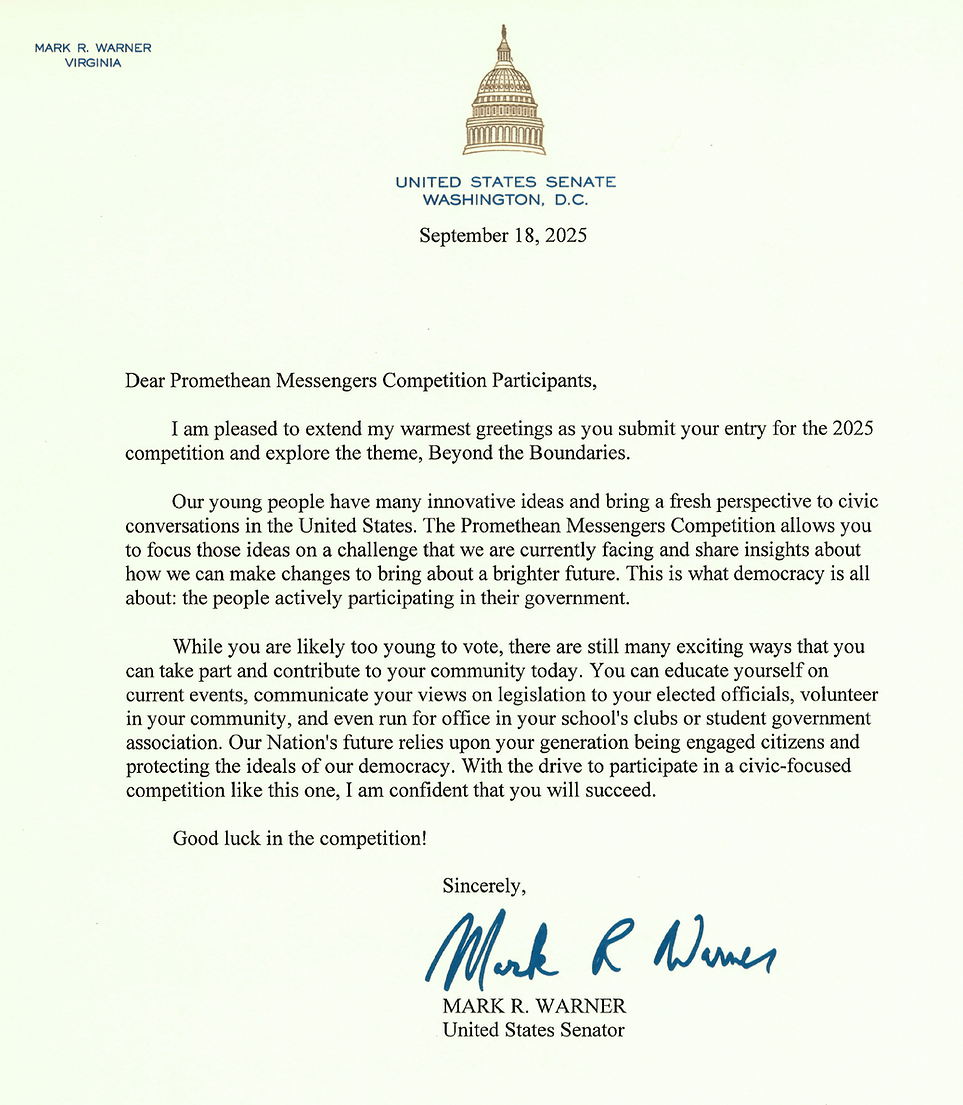
The Honorable
Mark Warner
U.S. Senator

The Honorable
James Walkinshaw
U.S. Congressman


The Honorable
Suhas Subramanyam
U.S. Congressman

Julie Yang
President of Montgomery County Board of Education
Promethean Messengers Competition makes me hopeful for the future. As the President of the Montgomery County Board of Education, I often consider what a future-ready education means for our students.
Real-life experiences have prepared me. When I first came to this country for graduate school, I had just a suitcase, a pocket dictionary, and a whole lot of hope and determination. I worked in restaurants and libraries, and I even tutored kids on how to get by. None of those jobs was glamorous, but every single one taught me about humility, hustle, resilience, problem-solving, and how to work with people. That—more than any textbook—prepared me for leadership.
That’s why future readiness for our young people isn’t just about test scores or diplomas. It’s about engaging in the community, understanding issues, developing creativity, and working collaboratively—all the skills that no machine, no app, and no shortcut can replace.
The Promethean Messenger Competition aims to help young people emerge from their bubbles, see the world critically, feel it deeply, and connect passionately. Then, they can express their experiences creatively. I encourage everyone to participate and let your voice come out through this amazing opportunity.
Julie Yang, President, Montgomery County Board of Education
Kee Jun
President of Coalition of Asian Pacific Americans of Virginia
On behalf of the Coalition of Asian Pacific Americans of Virginia, I extend my heartfelt congratulations to all who are participating in the Promethean Messengers Contest. This inspiring initiative, organized by student leader Andrew Huang reflects the power of young voices to bridge cultures, borders, and perspectives through the written word.
Participant’s creativity and dedication will remind us that the next generation of leaders is already shaping a brighter and more connected world. We are proud to support your efforts and encourage you to continue sharing your stories, your truths, and your vision for the future.
We commend, Andrew Huang, your leadership and passion in bringing together students from around the globe in this meaningful endeavor. To all participants, we wish you success and fulfillment as you embark on this journey of expression and discovery.
With great support,
Kee Jun
President of Coalition of Asian Pacific Americans of Virginia
A Letter from the Founder
Hi! I’m Andrew Huang, a senior at BASIS Independent McLean in Virginia in the U.S.
I’ve always loved writing, not just for the stories themselves but for the way they connect people who might never otherwise understand each other. A few years ago, I started Reading Across Borders, a nonprofit that’s worked on literacy projects in places like Senegal, Madagascar, China, and here in the US. In my community and in communities around the world, I've been privileged to meet students whose worlds looked completely different from mine. Yet somehow, our stories resonated with each other. That idea stuck with me: how words can travel farther than we can, and bridge things that politics or distance can’t.
Back at school, I started the Writing Workshop Club, a community where we share and critique each other’s work. It’s messy, funny, and honest, and it reminded me how good writing doesn’t just show who we are, it helps us listen to someone else.
This project grew from all of that. I wanted to build a space where young writers could use their voices to cross boundaries — cultural, emotional, political — and imagine something better.
For 2025, our theme is about breaking through barriers: not just the ones we see on maps or in headlines, but the quiet ones inside us: fear, doubt, division. How can writing make the world feel a little clearer, more hopeful, more open to change?
That’s the question we’re starting with. I can’t wait to see how you’ll answer it!
Warm regards,
Andrew Huang
To help participants engage deeply with
the 2025 theme, we’ve curated a list of
multidisciplinary resources spanning art, history,
activism, and innovation. Use these tools to
spark ideas, deepen your understanding,
and craft submissions that resonate globally.
Research & Inspirations

Social
Justice

Global Citizenship

Unity in Diversity


SHAPE THE FUTURE

